Lockouts · Scugog
Business Lockout Service
The heavy glass door has been scraping the threshold for weeks. This morning the key turns, you can hear the bolt trying to move, but it is jammed hard in the strike and the door stays shut no matter how the handle is pulled.
Business Lockout Service
In plain words
Commercial doors carry hardware that most homes never see, and reading it correctly is the first skill of a business lockout. An aluminium storefront door usually has a narrow mortise cylinder driving a hookbolt deadlock or a paddle-operated deadlatch. An office suite is more likely to have a lever lockset that stays locked from the corridor side, sometimes with a removable core. A rear door may carry an exit device with a keyed trim outside, and a steel door in a plaza often hides a full mortise lockset. Each of these opens differently, and choosing the technique that suits the mechanism is what keeps the hardware intact.
How the visit goesMinus eighteen with a wind, and the exterior cylinder on the shop door has frozen solid overnight after yesterday's slush. The key goes in halfway and stops. The delivery driver is due, the phone is ringing inside, and nobody can reach it.
Scugog
How the visit goes
Who is asking, and for which company
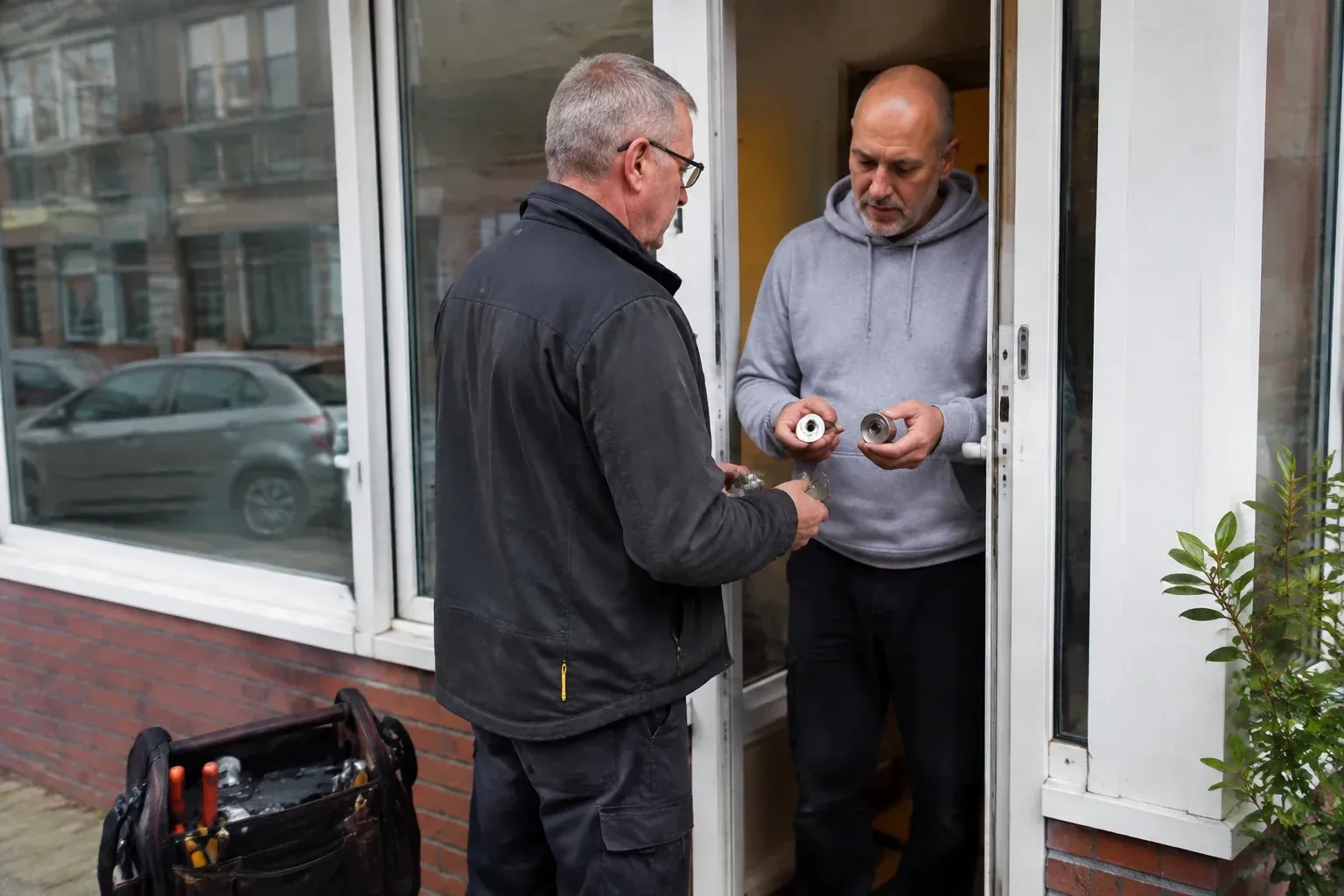
The first check is about authority to act for the business. An owner or director shows photo identification and a document that ties them to the premises, such as the lease, the business registration or a supplier invoice addressed to the unit. A manager or staff member is confirmed by a call to the owner, the head office or the property manager, using a number the locksmith can look up rather than one written on a scrap of paper. A landlord or their agent shows the lease clause or written instruction behind the request. When the paperwork is behind the locked door, the check is completed inside before the locksmith leaves.
Freeing a frozen or bound door
Ice and misalignment are dealt with by patience and leverage rather than force. A frozen storefront cylinder is treated with lock de-icer or gentle warmth until the plug turns, and the keyway is dried before a dry lubricant goes in. A door that has dropped on its pivots is lifted by hand or with a wedge to bring the bolt back in line with its strike while the cylinder is turned, and the bolt slides free. With the door open the cause is corrected so it does not repeat: pivots or the continuous hinge adjusted, the strike dressed or moved, the closer speed and latching force reset, and salt cleared from the threshold and bottom rail.
A keyholder plan so one absence never closes you
Most business lockouts trace back to a single keyholder, and the visit is the natural moment to fix that. Two named people should be able to open the premises, with a third who can be reached. A combination lockbox in a discreet spot, its code known to the opening staff and changed when someone leaves, covers the day the keyholder is stuck in traffic. For electrified doors, a second administrator on the access system means a forgotten code is an inconvenience, not a closure. Writing the opening and closing routine on one page, with the alarm company's number and the locksmith's, turns the next surprise into a short phone call.
Business Lockout Service
In the van
- Storefront deadlatch and hookbolt bypass tools
- Lock de-icer and dry PTFE lubricant
- Commercial pick and tension tools
- Broken key extractors
- Interchangeable cores pinned to system
What affects the quote
Same fees day, night or weekend
1Rekeying or swapping cores afterwards
Making a lost or unreturned key useless is separate work, priced per cylinder or per core, and the count of doors sharing that key decides how much of it there is.
2Standard or high-security cylinder
Restricted keyways, security pins and patented cylinders take longer to open and cost more to replace, and their keys are cut from system records rather than copied at a counter.
3Broken key extraction and cylinder service
Removing a snapped key, cleaning and lubricating the cylinder and replacing a worn cam or tailpiece are added to the opening when that is what caused it, and a new key cut from code follows.
Business Lockout Service: questions
Our alarm is armed. What happens when you open the door?
The opening is planned around it. Before any work, the person with the alarm code is ready to disarm, and where a monitoring company is involved they can be told to expect an entry at that address. If the contact trips anyway, the authorised person speaks to the station with the account password. Nothing about the alarm is bypassed; the door is opened, the system is disarmed normally, and the event is logged like any other.
What is a restricted keyway and is it worth having for a business?
A restricted or patented keyway is one whose blanks are supplied only through the manufacturer's authorised channels, so duplication is controlled rather than available at an ordinary counter, though the exact authorisation step varies by program and is not always a signed letter. For a company with staff turnover, cleaners and contractors, it means the keys in circulation are far easier to track. It can be introduced during a rekey, on the exterior doors only or across the whole premises, and works alongside a key register.
What is an interchangeable core, and how do I know if we have one?
An interchangeable core is a small, self-contained cylinder that slides out of the lock with a special control key and drops back in on a new combination. Look at the keyway: a figure-eight shaped face on a lever or mortise housing is the usual sign. Buildings choose them because a lost key or a staff change is handled by swapping the core rather than taking the lock apart, and a locksmith can carry cores pinned to your system.
Lockout Services
Business Lockout Service near you
One team handles every service on this page for Scugog, so a lockout can turn into a rekey, and a rekey into a properly set deadbolt, within the same visit if you want it. Each service is described separately below, but at the door they fit together as one piece of work.