Car keys · Scugog
Transponder Key Programming in Scugog
Every key that ever opened the car is gone at once, one taken with a stolen bag, the spare misplaced months ago and never replaced. There is no working key left anywhere in the house, the garage, or a coat pocket, and the car sits exactly where it was parked.
Transponder Key Programming
In plain words
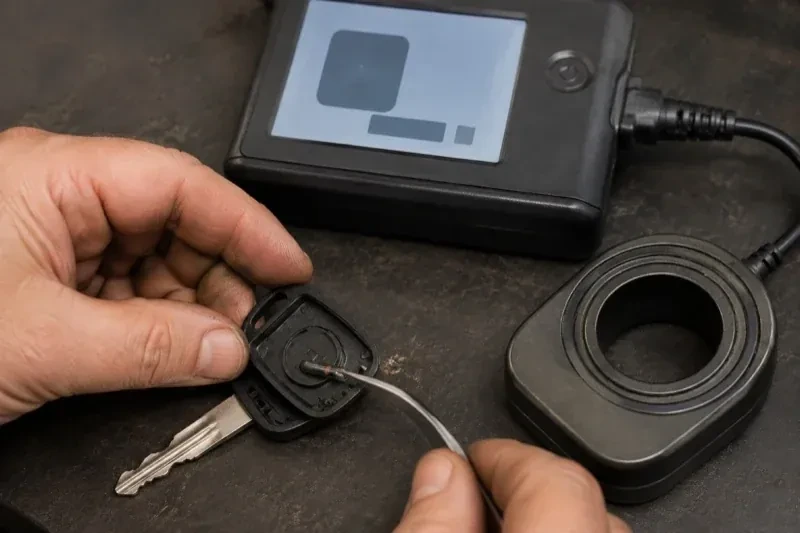
A modern car key is often two systems living in one housing: the transponder, a chip with no battery of its own that only the immobilizer needs to see, and the fob, a battery-powered remote that handles locking, unlocking and alarm functions from a distance. Programming a transponder key addresses the first system, letting the engine start, while pairing the fob addresses the second, restoring the buttons. A key can pass one test and fail the other, so both get checked before the visit is finished.
How the visit goesA second driver has joined the household, and the one existing key gets handed back and forth between two schedules that rarely line up. Everyone agrees another key would settle the daily handoff, but nobody has looked into how a modern ignition actually learns a new one.
Scugog
How the visit goes
Anything already added to the vehicle
Aftermarket remote starters, alarms, and a used ignition or control module carried over from another vehicle can all leave their own entries in a key list, sitting alongside the factory ones. Before programming anything new, the locksmith asks what has been added or swapped, since a module transplanted from elsewhere sometimes brings a stranger's old key identities with it. Sorting out what belongs to this vehicle and what arrived with a part keeps the finished key list honest rather than cluttered with entries nobody can explain.
Starting over when every key is gone
All-keys-lost work follows a different path, because there is no working key left to prove the vehicle's trust to a new one. The locksmith first re-establishes secure access to the immobilizer's own module, sometimes through the vehicle's manufacturer network, before a fresh key list can be written at all. Once that access is confirmed, the new key or keys are added the same way any other key would be, and the process finishes with the same start-up test as a routine replacement.
Leaving with a full set of working keys
The visit ends with every key that should work actually tested in the driver's own hands: the new one, and any older ones that were meant to keep working. Remote functions, if the vehicle has them, are checked at a normal distance, and the emergency insert on a proximity fob is pointed out rather than left for the owner to discover later. Nothing is assumed finished on the strength of a screen reporting success; the engine and the fob both had to prove it directly.
Transponder Key Programming
In the van
- Security-access module
- Chipped key blank
- Bench programming adapter
- Frequency test reader
- Proximity smart key
What affects the quote
Same fees day, night or weekend
1Manufacturer-gated security access some newer vehicles require
A number of newer vehicles require an additional secure session with the manufacturer's own network before a key can be added, which is a real step in the process on those models rather than an optional add-on.
2Time of the appointment
An appointment during regular daytime hours is scoped differently from one outside them, and the locksmith states which applies when the visit is booked so there is no surprise about it on arrival.
3Trim or dash removal some models need for access
A small number of vehicles place the antenna ring or module somewhere that needs a panel or trim piece moved for a clear connection, which adds a step beyond the programming itself on those specific models.
Transponder Key Programming: questions
Does the fob need a new battery every time a key is programmed?
Not necessarily, but it is checked every time regardless. A battery that is already weak is often easier to replace during the same visit than to leave for another call later, and a marginal battery can make a freshly programmed fob look like it has a fault when the chip itself is working exactly as intended.
What happens if every key for my car is gone?
All-keys-lost work starts by re-establishing secure access to the vehicle's own immobilizer module, since there is no existing key left to vouch for a new one. Once that access is confirmed, a fresh key is cut and its chip is written into the vehicle the same way any key would be, and the visit finishes with the usual start-up test across a few ignition cycles.
What's the difference between a transponder key and a key fob?
The transponder is the passive chip that talks to the immobilizer and lets the engine start; it needs no battery of its own. The fob is the separate, battery-powered piece that handles remote locking, unlocking and alarm functions. Many modern keys combine both in one housing, but they answer two different systems, which is why a fob with a dead battery can still start the car with its mechanical blade.
Car Keys
- Car Key ReplacementYou bought the car privately and it came with a single key on a shoelace.
- Spare Car Key DuplicationA lockout last month ended with a locksmith opening the door and going home, and the same single…
- Key Fob ProgrammingButtons on the fob still light up and the remote still clicks, but the vehicle refuses to start…
Transponder Key Programming near you
One team handles every service on this page for Scugog, so a lockout can turn into a rekey, and a rekey into a properly set deadbolt, within the same visit if you want it. Each service is described separately below, but at the door they fit together as one piece of work.